

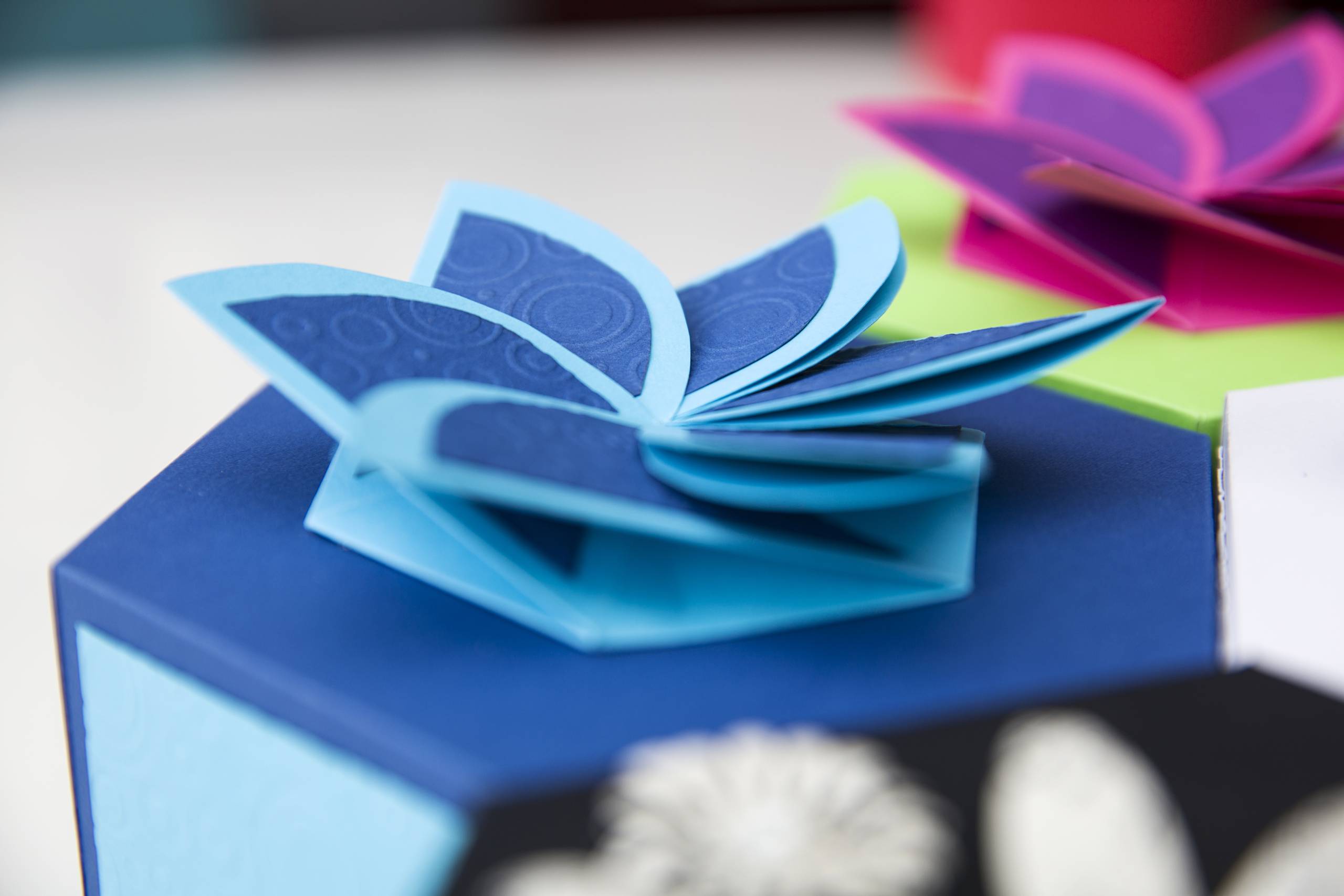
Folds can act as beams, hinges, and boundaries, based on where they’re placed and how they’re related to one another. With structural folding, paper becomes an active material, capable of holding up three-dimensional forms.
How does folding achieve this? The first step is to understand how paper responds to forces. Paper has strong and weak directions when it comes to folding. It also has strong and weak directions in terms of sheer resistance to tears. Its resistance changes based on the grain direction, its thickness, and how it’s already been manipulated. Folds can direct tension to places where it’s needed or wanted, spreading loads more evenly so they don’t cause the paper to buckle.
Repetition is another way to build strength. Repeated folds can create surface patterns that work like ribs in a shell. This doesn’t require perfectly symmetrical patterns, but it does require that the folds somehow make sense to one another. Folds that mirror each other across a form create visual and spatial rhythms that support the three-dimensional structure.
Folds also control how a sculpture fills its volume. Hard folds create sharp angles and bold geometries. Softer folds create curves and smooth transitions. The decision to use one or the other isn’t just a matter of style or taste, though. It depends on the form and scale of what you’re making. Large forms may benefit from strong, angular folds to help them hold their shape. Smaller forms or more detailed ones might rely more on rounded curves. Knowing when to apply each technique helps you create a form that looks intentional rather than arbitrary.
In general, folding logic is what differentiates a well-crafted sculpture from a more casual or crafty one. It lets you treat every fold as part of a system, where each crease contributes to the overall structure. As you develop your sense of folding logic, your decisions will become more assured and less experimental. You won’t ask yourself what will look cool or interesting. You’ll ask what the structure needs. And that will help you create paper sculptures that are stronger, longer-lasting, and more meaningful.